

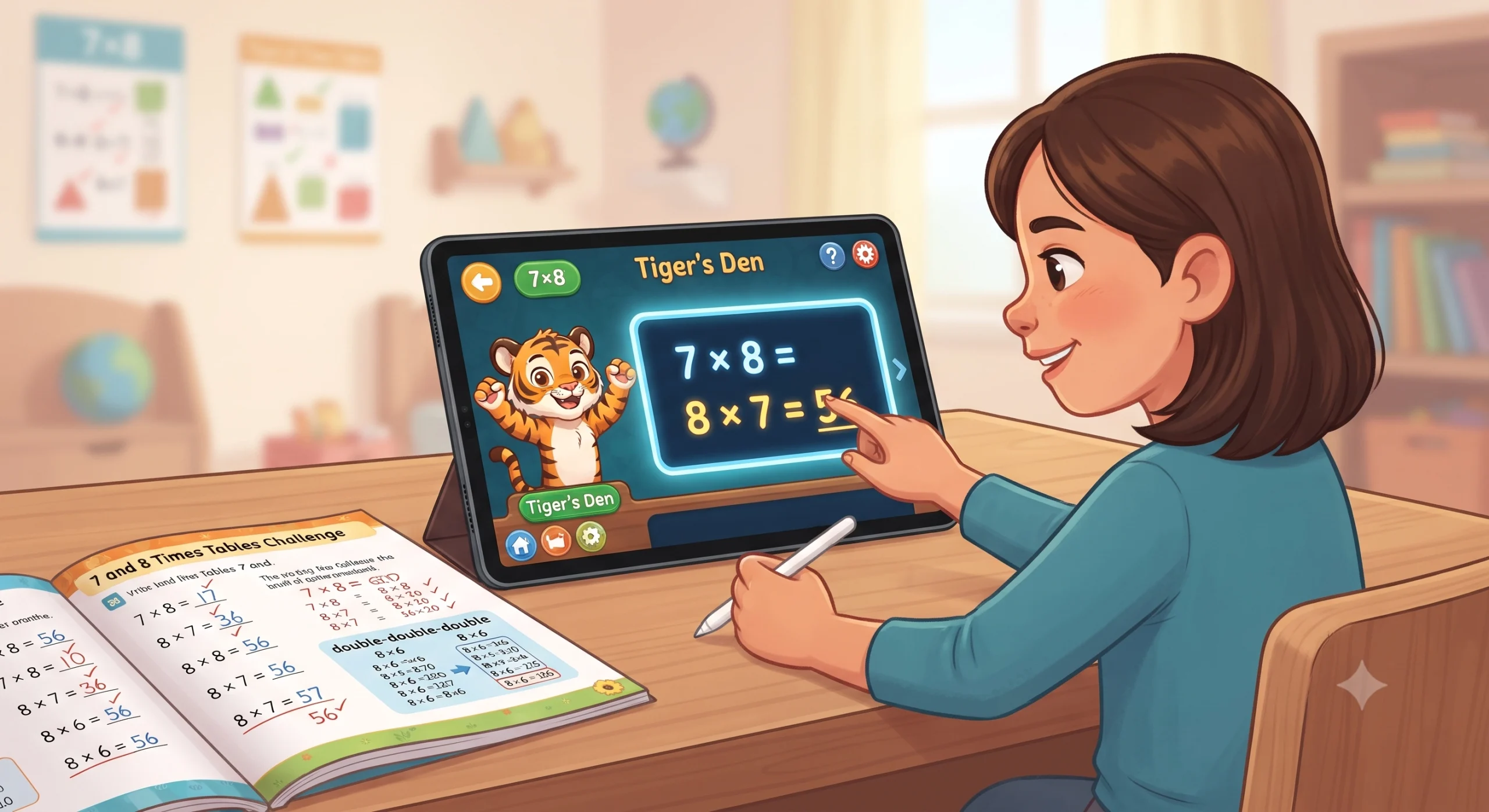
Ask any Year 4 teacher which times tables cause the most trouble, and two numbers come up almost every time: 7 and 8. They arrive late in the usual teaching order, they don’t follow the neat patterns children rely on for 2s, 5s and 10s, and they overlap awkwardly with each other (7 × 8 and 8 × 7 trip up even confident kids). Here’s how to actually get on top of them, rather than just drilling them harder.
Why 7 and 8 Are Genuinely Harder
Most times tables have some kind of pattern a child can lean on:
- The 2, 4 and 8 times tables all relate to doubling
- The 5 times table always ends in 0 or 5
- The 10 times table just adds a zero
- The 9 times table has a well-known finger trick and a digit-sum pattern
The 7 times table doesn’t have an easy shortcut, and the 8 times table, while technically “double double double 4,” asks a child to hold three doubling steps in their head at speed — which is often slower than simply knowing the fact outright. On top of that, by the time 7 and 8 are introduced, children are also facing larger numbers in general, so there’s more for working memory to juggle.
Key Challenges to Watch For
- Order-dependent recall. A child might answer “7 × 8” instantly but freeze on “8 × 7” — a sign the fact is memorised as a sequence, not truly known both ways round.
- Over-reliance on skip counting. Counting up in 7s or 8s to reach an answer works, but it’s far too slow for anything timed, including the MTC’s 6-second window.
- Avoidance. Children often unconsciously dodge the tables they find hardest, meaning 7s and 8s get less genuine practice time than 2s and 5s unless it’s deliberately corrected.
Practical Ways to Build Real Fluency
A few focused techniques work far better than simply repeating the times table from the start every time:
- Practise facts in both directions. Ask “7 × 8” and “8 × 7” as separate questions, not just one after the other, so the fact is genuinely secure regardless of which number comes first.
- Isolate the “leftover” facts. Most children already know 7 × 2, 7 × 5 and 7 × 10 comfortably. Focus deliberately on the ones that don’t have shortcuts: 7 × 3, 7 × 6, 7 × 7, 7 × 8, 7 × 9.
- Use the doubling method for 8s, but only as a bridge. “Double, double, double” is a useful way to first understand 8 × 6, but the goal should always be moving from that method to instant recall — not relying on it forever.
- Short, frequent bursts. Five minutes on just the 7 and 8 times tables, four or five times a week, builds fluency faster than one long mixed session covering every table at once.
- Track speed, not just correctness. A child getting 7 × 8 right after a five-second pause hasn’t yet built fluency — the aim is an answer within a second or two, said or written without visible effort.
How RoarMath Can Help
RoarMath’s shaky-fact radar is built for exactly this situation. Rather than treating every times table equally, it quietly tracks which individual facts a child answers slowly or incorrectly — so if 7 × 8 and 8 × 7 are consistently the weak points, those specific facts get pulled back into the next practice session automatically, without a parent having to notice the pattern themselves.
Inside the app, Tiger’s Den is a dedicated mode that spends a full minute concentrated purely on a child’s weakest facts, rather than mixing them in with tables they’ve already mastered — ideal for those stubborn 7 and 8 gaps that need extra repetition without extra boredom. And because every companion character in RoarMath is tied to a different part of times tables practice, working through the harder tables still feels like progress through the jungle camp rather than a chore.
Conclusion
The 7 and 8 times tables aren’t harder because a child isn’t trying — they’re genuinely harder to memorise, and they deserve more focused, more frequent, shorter bursts of practice rather than being lumped in with the easier tables. Once a child can answer 7 × 8 and 8 × 7 instantly, in either order, most of the remaining tables fall into place much faster.
Want practice that automatically finds and fixes the facts your child is still shaky on? Get early access to RoarMath and let the shaky-fact radar do the spotting for you.