

Most parents feel a familiar tension around screen time: it’s convenient, kids enjoy it, and yet there’s a nagging worry about whether the time is actually being spent well. That guilt gets even more complicated when an app claims to be “educational” — how do you actually tell whether it’s building a real skill, or just keeping a child occupied with a maths-flavoured game?
Why “Educational” Alone Isn’t a Useful Label
Almost every app aimed at children claims some educational value, because the label sells. But there’s a big difference between an app that occasionally features numbers and one that’s deliberately structured around a specific, measurable skill. The word “educational” on an app store listing tells you almost nothing on its own — what matters is what the app actually asks a child to do, minute by minute, and whether that activity maps to a real, well-defined learning outcome.
Key Challenges Parents Face When Choosing
- Marketing versus substance. App descriptions and screenshots are designed to sell downloads, not to explain pedagogy — it’s genuinely hard to tell from a store listing alone whether an app builds a real skill.
- Engagement mistaken for learning. An app can be highly engaging — bright colours, rewards, characters — while the actual task inside it teaches very little. Engagement and educational value aren’t the same thing, though they’re often confused.
- No visibility into progress. Many apps don’t show a parent anything meaningful about what a child has actually learned or improved at, making it impossible to judge whether the time spent was worthwhile.
- Vague or shifting goals. Apps that don’t target a specific skill tend to drift — a maths app with mini-games, quizzes, stories and rewards all bolted together, none pursued deeply enough to build real fluency in anything.
What Actually Makes an Educational App Worth the Screen Time
A few practical questions cut through the marketing and get to what actually matters:
- Does it target one specific, well-defined skill? Apps that focus deeply on one thing — like times tables fluency specifically — tend to build that skill far more effectively than broad “maths practice” apps covering everything shallowly.
- Can you see real progress, not just activity? Look for concrete measures — accuracy, speed, specific facts mastered — rather than vague indicators like “level 7” or “gold star.”
- Is the reward tied to genuine improvement? The best educational apps reward a child for actually getting better at the skill, not simply for opening the app or tapping through screens.
- Does it respect short session lengths? An app that works well in five-minute bursts fits far more naturally into daily life — and encourages healthier screen habits — than one designed to maximise time spent per session.
- Would the skill transfer without the app? If the core ability (in this case, instant times tables recall) would genuinely help a child in a classroom test, on paper, with no device in sight, that’s a strong sign the app is building something real.
How RoarMath Was Built With This in Mind
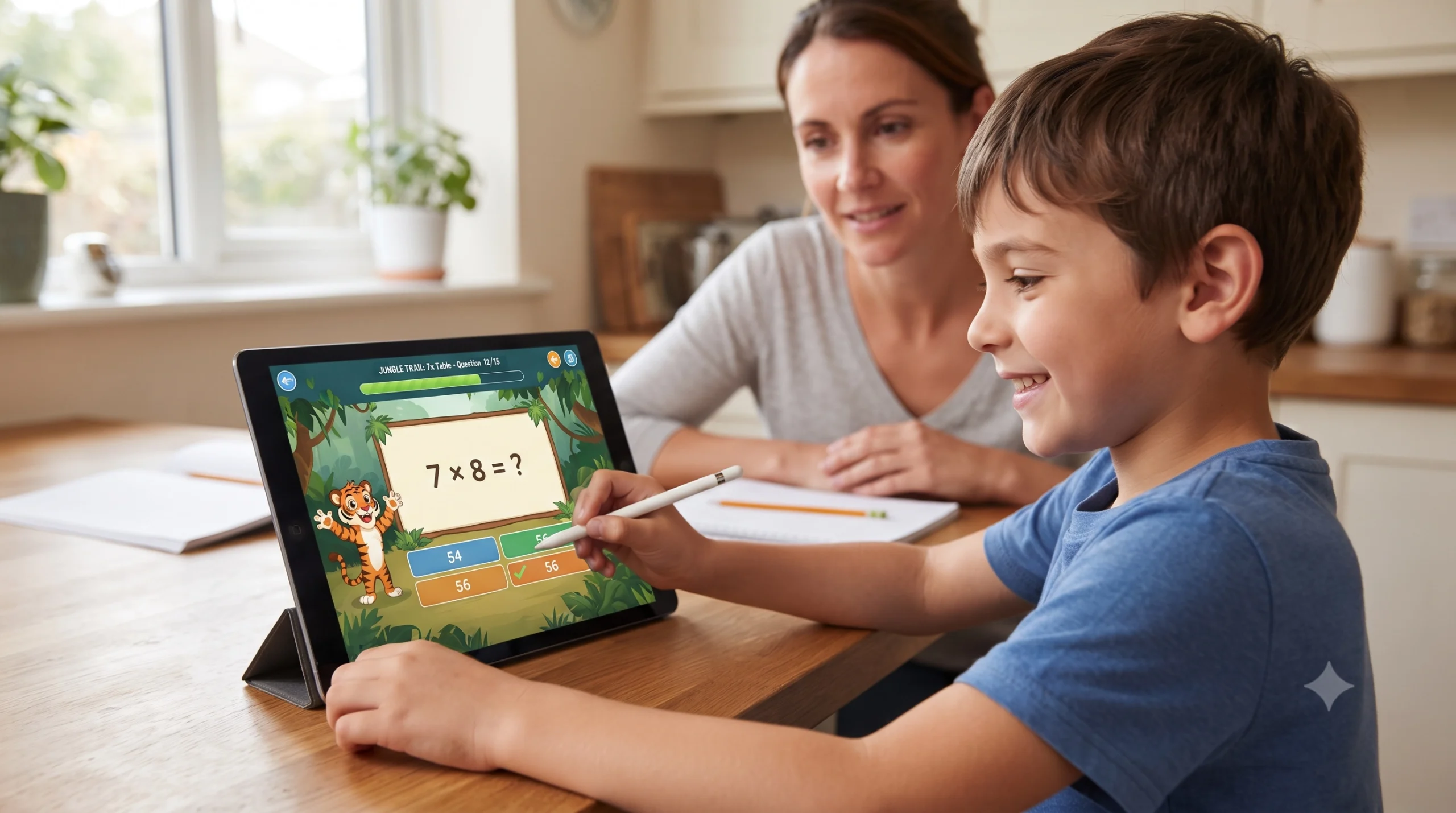
RoarMath focuses on exactly one skill: instant recall of multiplication and division facts. There’s no scattergun mix of unrelated maths topics diluting the practice — every mode in the app, from Jungle Trail to Jungle Checkpoint to Tiger’s Den, is built around that single, well-defined outcome.
Progress is genuinely measurable, not just decorative: RoarMath tracks accuracy and speed to the tenth of a second on every question, and a child’s rank — from Sapling through to Jungle King — is earned purely through faster average recall, not through unrelated in-app purchases or arbitrary level-ups. Sessions are also designed to be short by default, with Jungle Trail‘s 15-question camps fitting comfortably into five or ten minutes rather than encouraging long, open-ended play. And because the underlying skill is instant times tables recall, the benefit shows up directly in schoolwork and tests — with no device required to prove it.
Conclusion
Screen time guilt usually isn’t really about screens at all — it’s about not being sure whether the time is well spent. The fix isn’t avoiding educational apps altogether, but being more deliberate about what “educational” actually means for a given app: a specific skill, measurable progress, and rewards tied to real improvement rather than just engagement.
Looking for screen time that’s genuinely building a measurable skill? Get early access to RoarMath and see exactly what your child is improving at, every session.