
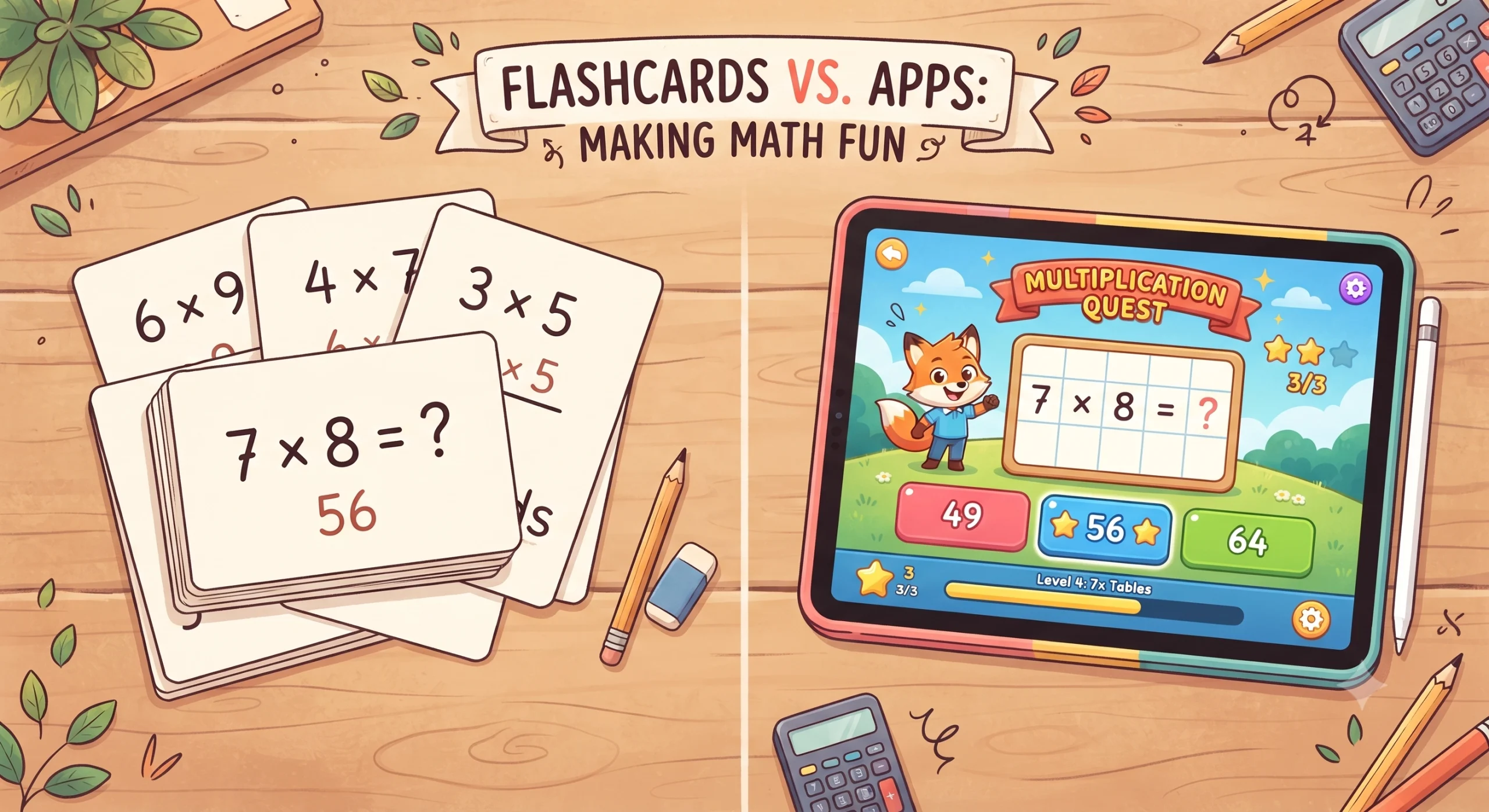
Flashcards have been the default tool for times tables practice for generations, and for good reason — they’re simple, cheap, and they work. But times tables apps have become the more common choice in many households over the past few years. Which one actually builds fluency faster? The honest answer is that it depends on what a family can realistically sustain, but there are some clear, practical differences worth understanding.
How Flashcards and Apps Each Approach Fluency
Both tools are built around the same core idea that actually builds times tables fluency: retrieval practice, meaning repeatedly recalling a fact from memory rather than passively reading or reciting it. Where they differ is in execution.
Flashcards require a second person to hold them, present a random card, judge whether the answer was correct, and track which cards need repeating — done well, this is genuinely effective, but it depends entirely on that second person being available, patient, and consistent, session after session.
Apps automate that same process. They present facts in random order, judge correctness (and, in better apps, speed) automatically, and can track exactly which facts still need work without a parent having to remember or notice the pattern themselves.
Key Challenges With Each Approach
Flashcards
- They require a present, engaged adult every session. Fluency-building only works if someone is available to run the cards regularly — which is often the first thing to slip when life gets busy.
- Timing is inconsistent. Without a stopwatch, “fast enough” becomes a judgement call that can vary session to session, making it hard to track genuine speed improvement over time.
- No built-in tracking. Remembering which specific facts a child struggled with last week, and making sure those come up again this week, relies entirely on the adult’s memory or a manual system.
- Motivation can flag. Without built-in rewards or visible progress, flashcard sessions can start to feel like a chore for both child and parent.
Apps
- Quality varies enormously. Not all “times tables apps” are built around genuine retrieval practice — some are closer to games with numbers loosely attached.
- Engagement doesn’t always mean learning. An app can hold a child’s attention through rewards and characters while doing very little to build actual instant recall.
- Screen time concerns. Even a genuinely effective app still means more time on a device, which some families are actively trying to limit.
Practical Guidance for Choosing (or Combining Both)
- Use flashcards when consistency of an adult’s time is genuinely reliable. If five minutes together, most days, is realistic for your family, flashcards work extremely well and cost nothing.
- Use an app when independence matters. If practice needs to happen without an adult available every single time — during a commute, before dinner is ready, or simply on a busy day — a well-designed app fills that gap without losing the retrieval-practice benefit.
- Look for automatic tracking, whichever you choose. Whether it’s a simple notebook alongside flashcards or built-in tracking in an app, knowing which specific facts are still weak is what makes practice efficient rather than repetitive.
- Prioritise timing. Since true fluency is about speed as much as accuracy, whichever method is used should include some form of timing, even informally with flashcards.
- Combine them if it suits your routine. Many families get the best results using an app for consistent daily practice and occasional flashcard sessions together as a change of pace, or vice versa.
How RoarMath Can Help
RoarMath was built to capture what makes flashcards genuinely effective — random order, honest timing, and targeted repetition of weak facts — without requiring an adult to be present and available for every single session. Every question is timed to the tenth of a second, facts are presented out of sequence rather than in table order, and the shaky-fact radar automatically tracks which specific facts need more repetition, feeding them back into future sessions without a parent needing to notice or remember.
Because Jungle Trail sessions are short by design, RoarMath fits into the same small pockets of time flashcards traditionally filled, but works just as well independently — during a car journey, a waiting room, or five minutes before dinner — while still preserving the core retrieval-practice mechanics that make either method effective in the first place.
Conclusion
Flashcards and apps aren’t really in competition — they’re two different delivery mechanisms for the same underlying method: timed, randomised, targeted retrieval practice. The right choice depends on how consistently an adult can be present, and how important independent practice is for your family’s routine. What matters most, whichever you choose, is that the practice is genuinely timed and genuinely targeted at the facts still causing trouble.
Want the effectiveness of well-run flashcard practice, without needing to be in the room every time? Get early access to RoarMath and let it handle the timing and targeting for you.