
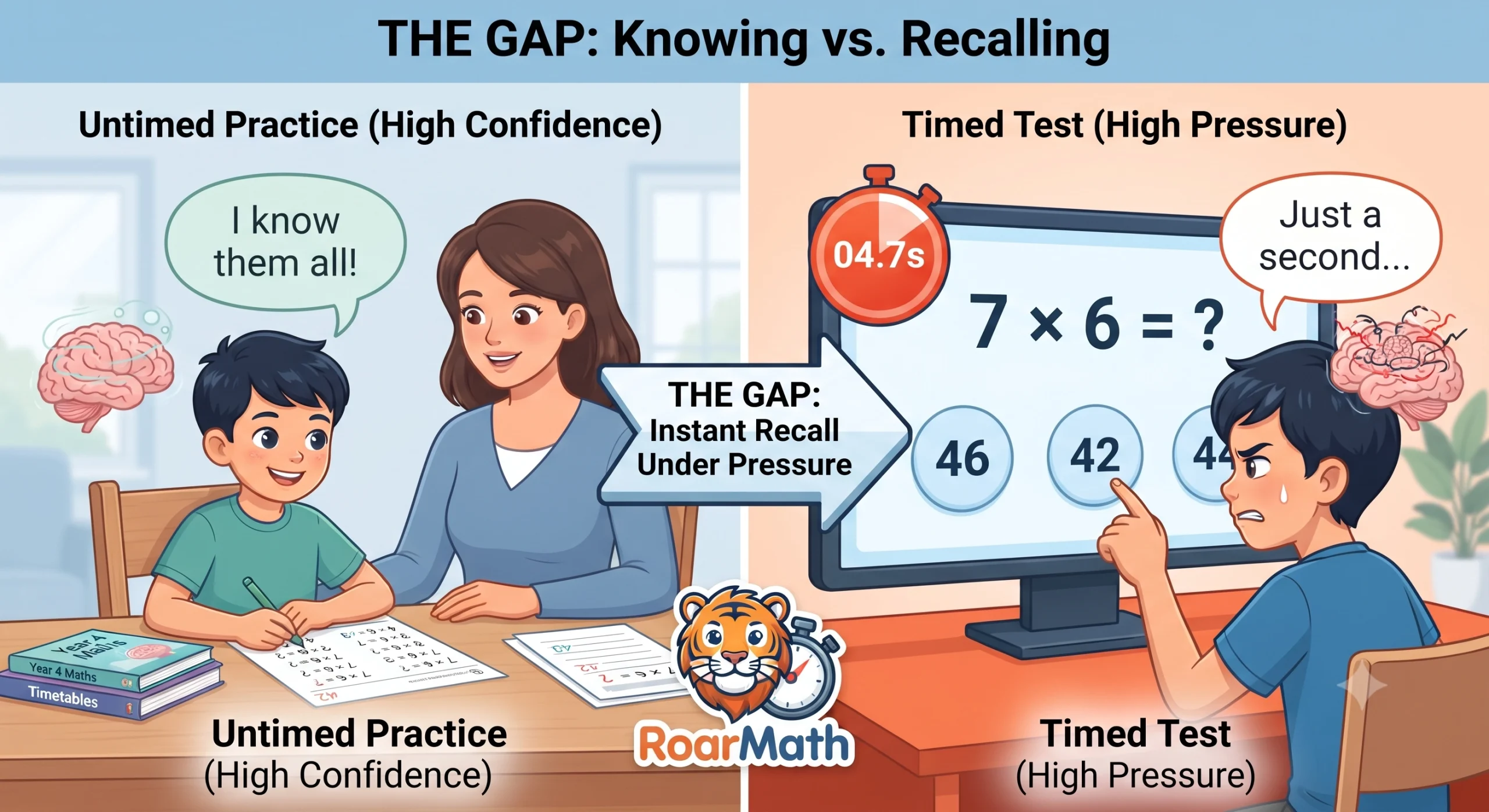
It’s one of the most confusing moments for a parent: your child can recite their times tables confidently at home, yet comes back from a timed test or the Multiplication Tables Check with a lower score than expected. It isn’t laziness, and it isn’t that they “forgot.” It’s usually a gap between two very different skills — knowing an answer, and recalling it instantly under pressure.
Why Knowing Isn’t the Same as Fluency
There are, broadly, three different ways a child can arrive at “7 × 6 = 42”:
- Working it out. Counting up in 6s, using repeated addition, or doubling and adjusting. This works, but it takes several seconds and uses up working memory.
- Recognising it. The child has seen the fact often enough that it feels familiar, and with a moment’s thought, the answer comes.
- Instant recall. The answer appears in under a second or two, with no visible calculation at all — the fact is simply known, the same way most adults know 2 + 2 = 4.
Only the third stage counts as true fluency, and it’s the only one fast enough to survive a strict time limit like the MTC’s 6 seconds per question. A child can be entirely accurate at home, where there’s no clock and no pressure, while still sitting in stage one or two for a meaningful number of facts.
Key Challenges Behind the Gap
- Untimed practice masks the problem. Worksheets and verbal quizzing at home rarely have a strict timer, so a child who takes four or five seconds to work something out still gets marked “correct” — even though that’s too slow for a real timed test.
- Order dependency. Many children learn tables in sequence (1×, 2×, 3× and so on) and become fast at reciting them in that order, but slow down noticeably when facts are asked randomly, exactly as they are in the MTC.
- Working memory load under pressure. Timers and test conditions add a layer of stress that can slow down recall even for facts a child normally knows well — this is a real, well-documented effect, not a sign of poor preparation.
- Uneven fluency across tables. A child might have true instant recall for the 2, 5 and 10 times tables, but still be “working it out” for 6, 7, 8 and 9 — dragging down their overall timed performance even though most of their knowledge is solid.
Practical Solutions That Close the Gap
The fix isn’t more repetition of the same untimed practice — it’s practice that specifically targets speed under realistic conditions:
- Introduce a timer early. Once a table is “known,” start timing responses, even informally, so slow recall becomes visible rather than hidden behind an eventually-correct answer.
- Practise out of order. Randomise which fact is asked next, rather than always working through a table from the beginning — this trains the actual retrieval skill the MTC tests.
- Separate “known” from “fast.” Keep a simple mental note (or use an app that tracks it automatically) of which facts are answered instantly versus which ones still take a pause — and give the slower ones extra focused practice.
- Build speed gradually. Don’t jump straight to strict 6-second pressure. Start with a slightly longer window and tighten it over a few weeks as genuine fluency develops.
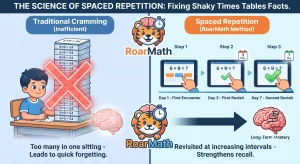
- Keep sessions short but frequent. Fluency is built by frequent retrieval practice over time, not by long single sessions — five minutes daily beats thirty minutes once a week.
How RoarMath Can Help
This exact accuracy-versus-speed gap is the reason RoarMath times every single answer to the tenth of a second, rather than simply marking questions right or wrong. A fact only counts as truly fluent once it’s answered both correctly and quickly — which means the app can tell the difference between a child who has genuinely mastered a fact and one who is still quietly working it out under the surface.
Facts that are correct but slow are exactly what RoarMath’s shaky-fact radar is designed to catch, feeding them back into future sessions via Tiger’s Den until they become instant. Meanwhile, RoarMath’s rank system — from Sapling up to Jungle King — is based purely on average seconds per correct answer, so a child’s progress is measured on the skill that actually matters for timed tests, not just on whether they eventually get answers right.
Conclusion
A child who “knows” their times tables but underperforms on a timed check almost always has a speed problem, not a knowledge problem — and speed is trainable, with the right kind of practice. Timed, randomised, frequent retrieval closes this gap far faster than more of the same untimed drilling.
Want to know exactly which facts your child has truly mastered versus which ones are still just “worked out”? Get early access to RoarMath and let it track the difference for you.