
If your child keeps getting the same handful of times tables facts wrong, week after week, the instinctive response is usually “practise more.” But more of the same practice often isn’t the answer — the real issue is usually when those facts get revisited, not how often. This is where the science of spaced repetition comes in, and it’s quietly becoming one of the most important ideas in how modern learning tools are designed.
What Spaced Repetition Actually Is
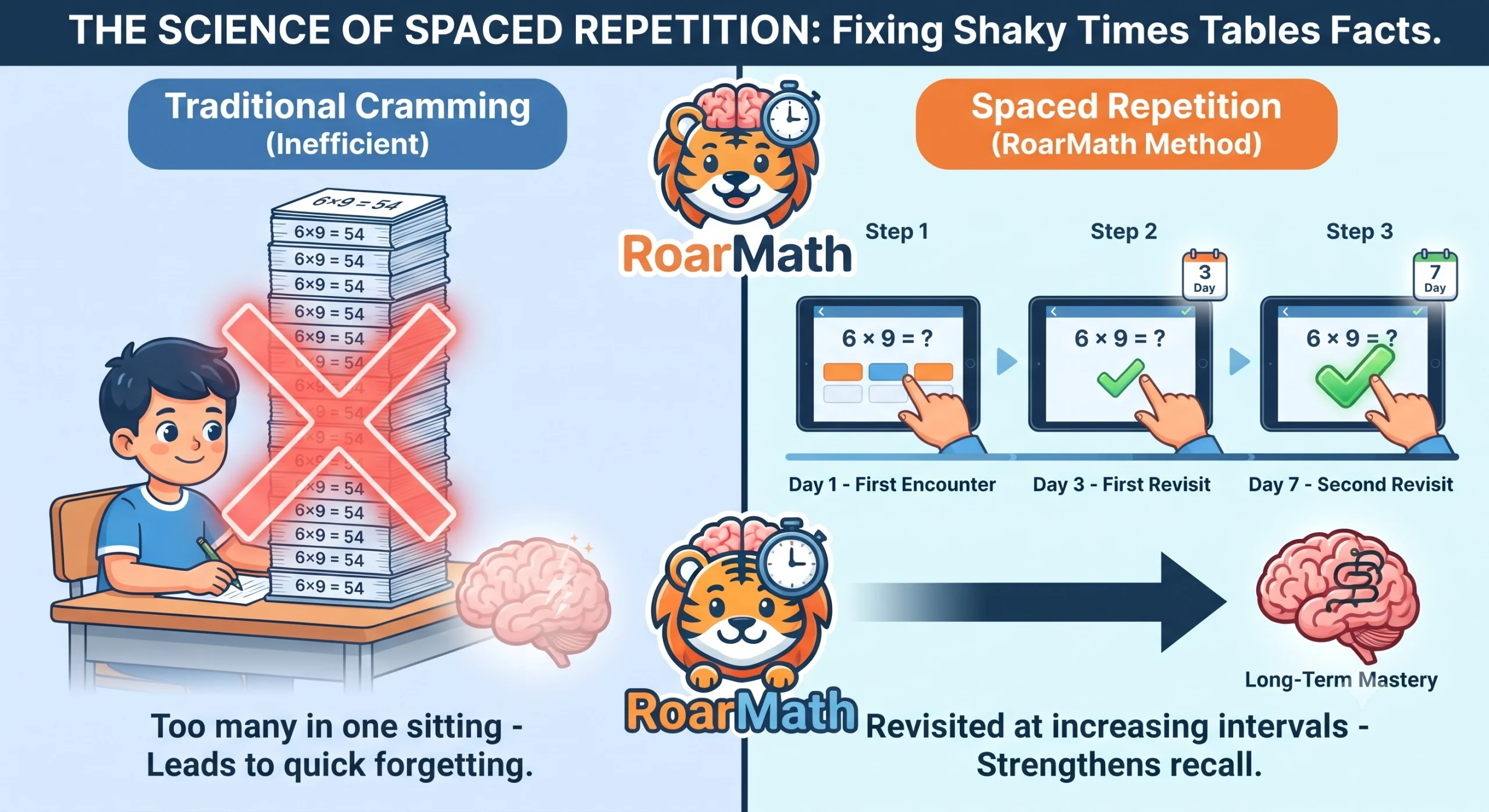
Spaced repetition is based on a well-established finding in memory research: information is retained far better when it’s revisited at increasing intervals over time, rather than repeated many times in a single sitting. Cramming a fact ten times in a row feels productive in the moment, but most of that repetition is wasted — the brain is essentially re-reading something already fresh in short-term memory.
Revisiting the same fact after a day, then a few days, then a week, forces the brain to actually retrieve it from memory each time, rather than simply recognise it. That retrieval effort is what strengthens long-term recall — and it’s a very different mechanism from simple repetition.
Why “Shaky Facts” Need This More Than Solid Ones
Facts a child already knows well don’t need much revisiting — a small amount of occasional practice keeps them fresh. But the facts that keep tripping a child up, the genuinely “shaky” ones, are exactly where spaced, targeted retrieval makes the biggest difference. Treating a shaky fact the same as a solid one — equal repetition, no extra attention — is one of the most common reasons times tables practice stalls on the same handful of facts for weeks.
Key Challenges With Traditional Practice Methods
- Equal treatment of all facts. Most worksheets and flashcard routines work straight through an entire times table, giving a fact a child already knows the same attention as one they consistently get wrong.
- No memory of past mistakes. Without a system tracking which facts were wrong last time, the same errors can resurface repeatedly without ever being deliberately targeted.
- Practice that’s too infrequent, or too frequent. Revisiting a shaky fact only once a fortnight is too spaced out to build recall; drilling it fifteen times in one sitting is too concentrated to build lasting memory. Neither matches how memory actually consolidates.
- Parental effort required to spot patterns. Noticing that a specific fact — say, 6 × 9 — keeps causing trouble takes careful, ongoing attention that’s easy to lose track of amid everyday life.
Practical Ways to Apply Spaced Repetition at Home
- Keep a simple running list. Note down facts that cause noticeable hesitation or errors, and deliberately bring them back into practice a day or two later, rather than moving straight on.
- Don’t over-drill in one sitting. Three or four repeats of a shaky fact in a single session is usually enough — more than that adds little extra benefit and increases frustration.
- Space the revisits out. Bring a shaky fact back the next day, then a few days later, then roughly a week later, gradually increasing the gap once it starts feeling solid.
- Prioritise ruthlessly. Spend the majority of practice time on the handful of genuinely weak facts, rather than spreading attention evenly across an entire times table.
- Let a tool do the tracking, if possible. Since spaced repetition depends on consistently remembering which facts need revisiting and when, this is exactly the kind of task well suited to automation.
How RoarMath Can Help
RoarMath’s shaky-fact radar is built specifically around this principle. Rather than treating every fact equally, it identifies which ones a child answers slowly or incorrectly, and automatically brings those specific facts back into upcoming sessions — spaced out naturally across future practice rather than repeated all at once.
Inside the app, Tiger’s Den takes this further, dedicating a full focused minute to a child’s current weakest facts, giving genuinely shaky knowledge the concentrated, targeted attention it needs without diluting it across facts already mastered. Because RoarMath tracks every answer’s speed and accuracy automatically, none of this relies on a parent noticing patterns or manually keeping a list — the spaced, targeted repetition that memory research supports simply happens in the background, session after session.
Conclusion
The instinct to “practise more” when a fact won’t stick is understandable, but the more effective fix is practising that fact differently — spaced out, targeted, and revisited just as it starts to fade rather than crammed all at once. This is a small shift in approach that makes a genuinely large difference to how quickly shaky facts turn solid.
Want your child’s weakest facts automatically tracked and revisited at the right intervals? Get early access to RoarMath and let the shaky-fact radar handle the spacing for you.